
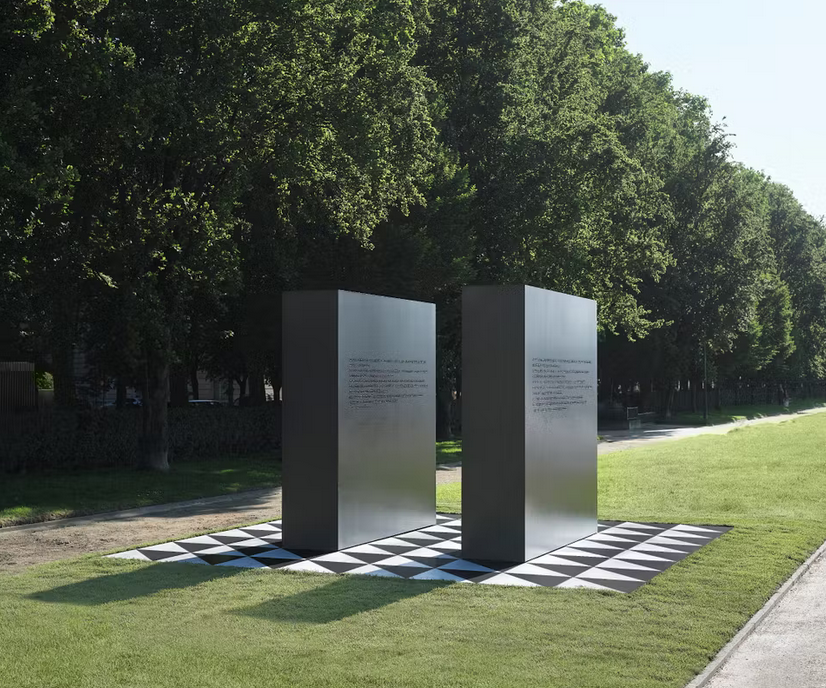
Rwandan President Paul Kagame and French President Emmanuel Macron today 02th June 2026 inaugurated a permanent memorial in Paris dedicated to the victims of the 1994 Genocide against the Tutsi in Rwanda.
Located on the Habib-Bourguiba Esplanade overlooking the Seine River, the memorial was created by internationally renowned artist Grada Kilomba. The artwork consists of two black brass monoliths placed on a lava-stone platform inspired by traditional Rwandan Imigongo art.
The monument serves as a place of remembrance for the more than one million men, women, and children who were killed during the Genocide against the Tutsi between April and July 1994. Inscribed on the memorial are messages honoring the memories, voices, experiences, and hopes of victims and survivors. The text appears in French, English, Kinyarwanda, and Swahili.
The names of Rwanda’s major genocide memorial sites :Nyamata, Murambi, Gisozi, and Bisesero—are also engraved on the structure, linking the memorial in Paris to places where the history of the genocide is preserved and commemorated.
The inauguration marks a significant moment in the relationship between France and Rwanda. Over the years, questions surrounding France’s role during the genocide have been the subject of extensive historical and political debate. In 2021, a commission of historians concluded that France bore “serious and overwhelming responsibilities” in the events leading up to the genocide. During a visit to Kigali the same year, President Macron acknowledged France’s responsibility in the tragedy.
According to Marcel Kabanda, the memorial represents an important milestone in preserving the memory of the victims and educating future generations about the consequences of hatred, division, and genocide. He emphasized that France needed a permanent national monument dedicated specifically to the memory of the victims of the Genocide against the Tutsi.
The project was launched jointly by the French State and the City of Paris following years of advocacy by survivor organizations, including Ibuka France. The memorial was commissioned through a public competition and supported by the French cultural authorities.
Artist Grada Kilomba explained that her original concept involved a more figurative representation. However, after visiting Rwanda and meeting survivors and descendants of victims, she chose a minimalist design. She believed that abstraction would better express the scale of the tragedy while respecting the dignity of those affected.
The lava-stone platform beneath the memorial was designed to evoke a fragment of Rwandan soil in the heart of Paris. Visitors are invited to walk across it and reflect on the lives lost, the resilience of survivors, and the importance of preventing future atrocities.
The space between the two monoliths has also been given symbolic meaning. For many observers, it represents the absence left by those who were killed, while at the same time creating a place for dialogue, remembrance, and reflection.
As France and Rwanda continue strengthening their relationship, the memorial stands as a lasting tribute to the victims of the Genocide against the Tutsi and a reminder of the responsibility to preserve historical truth and promote peace, justice, and human dignity.